Rails, not just instructions
I work with artificial intelligences that write code. Asking them nicely is not enough: what matters is what they cannot skip.
· Workshop · Written by: Álvaro García Graña · Reading time: 3 min · Project: Galivelop-workflow
The word: What a “harness” is
A harness is what a climber wears. It does not climb for you or tell you where to go. It only stops one bad step from becoming a fall.
That is my name for everything around the artificial intelligence when it works with me: the rules, the checks, the notes it leaves and the moment a person says yes or no. It is duller than the AI itself, and it is what lets me trust the result.
What went wrong: A written rule is not enough
At first I wrote everything down as rules: do this, do not do that. The AI read them, understood them and, now and then, broke them anyway. Not out of bad faith: halfway through a long job, a rule is one more sentence among thousands.
A small example. I had written that tests may only use fake email addresses, the kind reserved for examples. One day a different one slipped in. I saw it late, just before publishing, and fixing it meant undoing work that was already saved.
Decision
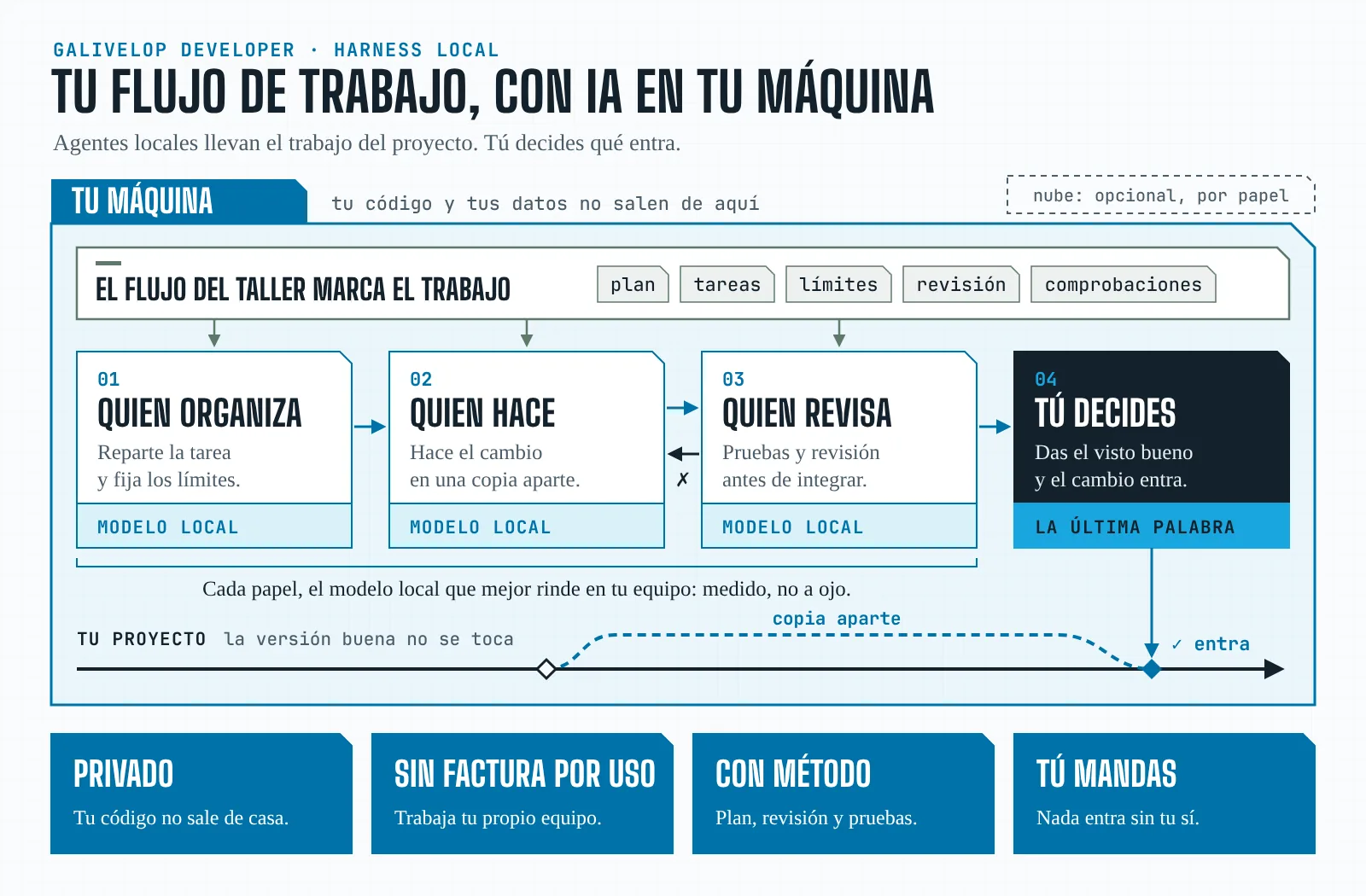
If a rule is broken more than once, it stops being a rule and becomes an automatic check. Whatever can be checked is checked by a machine, the same way every time, and the AI is left with what needs judgement.
My rule about rules
- Context grows: Every call reads the whole conversation again: the longer it is, the more it costs. That is why mechanical work goes to subagents and the window has a limit.
- Compact: When it reaches the limit, the conversation is compacted. A hook runs recover.py and brings the state back from git: the session carries on from the same step.
- Cut-off: The session ends: out of tokens, with the container recycled or handed over to another account. What was only in the conversation is lost; what was pushed is not.
- Handover: Another session, maybe on another account, starts, reads the log and picks up at “Siguiente:” without asking where things stood. What is not pushed does not exist.
The rails: Four things that cannot be skipped
What holds the work up
- What is not saved does not exist. The AI forgets everything when the session ends, so it saves often and leaves a note for whoever comes next.
- A test must have failed first. If it has never gone red, I do not know whether it is really watching anything.
- Nothing is published while the checks are red. Not in a hurry, and not even if I ask for it.
- Publishing is a person's decision. The AI proposes, a second look reviews, and the last word is human.
What I learned: The harness takes nothing away
None of this makes the AI infallible. It still gets things wrong, and so do I. The difference is where the mistake ends up: in a check that goes off in time, and not on the website you are reading.
I like to think of it this way: the better the harness, the higher I dare to climb. The method is published and anyone can see it on the Galivelop-workflow page.